
In the words of Hollywood actress Angelina Jolie, “The sun doesn’t lose its beauty when covered by the clouds. The same way your beauty doesn’t fade away when being covered by Hijab.”
For ages, the Islamic attires of women, irrespective of the place, have continued to be a topic of discussion. Often, hijab is publically viewed as something forced and oppressive. However, in a world like today, freedom is the talk of the hour and the motivation of various protests and open rebellions, Islamic hijab is not something that can be considered onerous. The women today, most of them, choose to wear hijab because they find it liberating and empowering.
The constant need to defend their own choice to wear hijab, burqas, or kaftans (permanently or temporary) has left most of the women exhausted. Hijab and other Islamic outfits have now become a powerful medium to express one’s faith, and personality.

Islamic dress marks the point where lines between fashion, faith, and politics begin to blur. The fashion of such Muslim clothing does not negate the faith, even though it is restrictive (based on certain perspectives), continues to blend with the fashion trends.
Muslim dress fashion evolution
Clothing and fashion trends have evolved and invaded the lives of the rich and the poor alike. The most significant example is the Muslim women clothing – hijab, niqab, kaftan, burqa, abaya, etc. The traditional attires which comes with the covered styles of dressing began to transform into more fashionable styles while adhering to its religious beliefs at the same time. The Islamic clothing for women rightfully serves to ameliorate the personality of the Muslim women. Today, even the basic modest Muslim clothing are available in all ranges, from cheap and basic to exorbitant and designer:
Burqa – Burkas are the fully covered Islamic clothes with only a pellucid screen before the eyes as opening, Kaftan – a variant of womens robe or tunic with long sleeves and reaching up to the ankles, Hijab – an Islamic scarf that leaves the face uncovered and many more.
Kaftans – the modest Muslim dresses
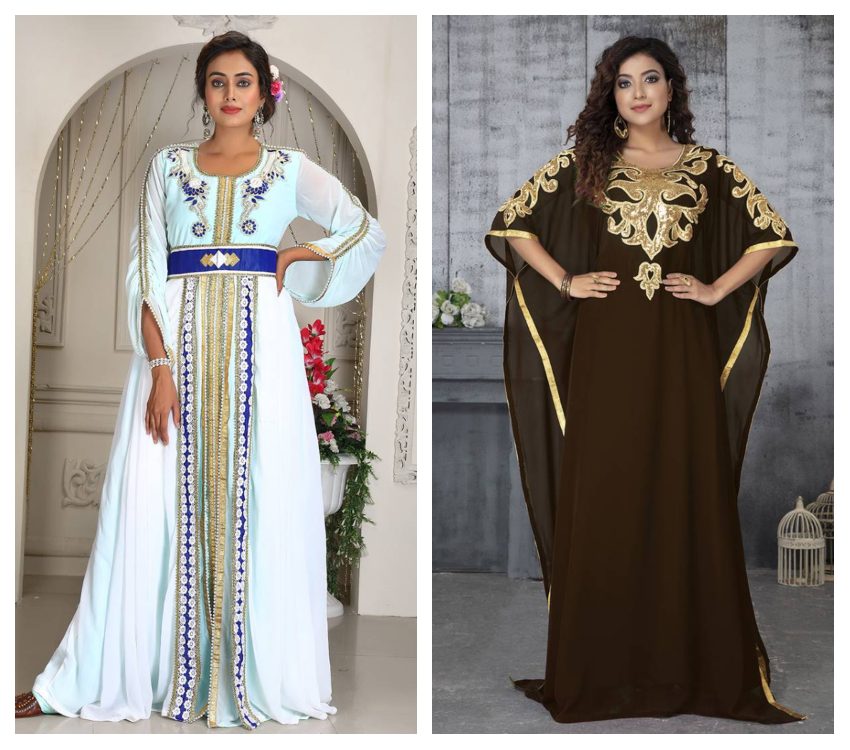
Kaftan dresses are loose-fitted Islamic dresses that cover the entire body and leave the face exposed. Kaftan dress may have an Islamic wellspring but it is cramped no longer to the tastes of the Muslim women, rather, it is now a modest Muslim clothing fashion style and trend adored, coveted, and adopted even by the non-Muslim women, all over the world. It is available in various designs and colors and made of exotic material to add to the charm of the wearer. The styles and uses of Islamic Kaftan dresses vary from person to person and place to place. It is one of the dress can be worn as an overcoat or an overdress.
Burqa – an Islamic wear for women
Burqas, like the kaftans, are swaddling garments. The burka covers the complete body, including the face. This particular modest Islamic clothing style has, for most of the past, been a political issue and therefore remains banned in about thirteen nations. It is one of the Muslim clothing that is still considered to be oppressive, a debatable statement.
Modest Islamic clothing demand is on rise
Recent surveys indicate that the demand for Islamic clothing keeps rising by around 10-20 percent every year on average. The market for Islamic outfits is huge especially in Asia, i.e. around $58 billion. Indonesia, followed by Malaysia, exports the most number of Modest and stylish Muslim clothes in the world. Islam is the fastest-growing religion and secondly, due to the consistent Muslims who continue to follow their faith even in the desperate times of global secularity. Muslim Clothing has risen from being cramped by faith to being a source and a medium to convey freedom and liberation among women. Clothing styles and fashion trends are one of the most important elements of a human’s life and Islamic clothing just seems to be a cherry on the top.
 Miss Fashion Smoke Blog
Leave a comment